
Bringing up a live camera stream with inference overlays on an edge AI device involves more steps than most developers expect the first time they attempt it. The device profile needs to be verified, model availability needs to be confirmed against the specific SoC and SDK version, and an execution path needs to be selected from among the accelerator options the hardware exposes. The capture pipeline, post-processing chain, and overlay rendering all need to be configured for the target device’s memory and compute budget. And the full chain needs to be validated under real runtime conditions, on the actual hardware, before anyone can trust the result.
Each of those steps depends on knowledge that often lives in undocumented scripts, internal team memory, or the experience of the one engineer who has set up that particular pipeline on that particular board before. This kind of expertise is valuable. It is also difficult to transfer and slow to scale across a growing developer ecosystem.
The first piece in this series, “Everything Is Going to Be Driven by Algorithms,” described the migration of intelligence from the cloud to the edge: the shift from stateless inference pipelines to agentic workflows that pursue goals, use tools, and maintain state over time. That piece concluded with the argument that agentic edge AI is fundamentally a systems engineering problem. The question it left open is whether the tools developers use today are adequate for that kind of work. They are not.
The feedback loop is different at the edge
The current generation of AI-assisted coding tools has proven remarkably capable for general-purpose software development. These tools can draft functions, refactor codebases, generate tests, and reason across multi-file repositories. They work well in environments where the feedback loop between writing code and evaluating it is fast and entirely software-contained. A developer writes a function, the tool suggests a completion, the test suite runs, and the result is visible in seconds.
Edge AI development operates under a different feedback structure. The loop extends through physical hardware. A line of code may be syntactically correct and still fail at runtime because the target device does not expose the required accelerator, or because the SDK version supports a different execution path than the one the tool assumed. In cloud-native development, a passing test generally means the code works. In embedded development, a passing test means the code works on the machine that ran the test. Whether it works on the target device is a separate question that requires a separate verification step, and that step requires access to the device itself.
This distinction creates a specific failure mode. An AI coding assistant produces output that is fluent, well-structured, and plausible. The device, however, demands output that is precise: correct for the specific SoC, the specific SDK version, the specific accelerator configuration, and the specific runtime state. When fluency and precision diverge, the cost of debugging the gap often exceeds the time saved by generating the code in the first place. Engineering teams that have encountered this pattern tend to develop a cautious posture toward AI-generated code for embedded targets, and that caution has a basis in repeated experience.
Platform expertise as the scaling constraint
The difficulty is compounded by the nature of the expertise involved. Edge AI platforms are not generic computing environments. A single SoC family may span multiple generations, each with different SDK versions, different sets of hardware operators, different model format support, and different optimal execution paths. The same high-level task, running object detection on a live camera feed, may require a materially different implementation sequence on two devices in the same product line, depending on which accelerators and operators are present.
In most organizations, the people who know how to navigate this complexity are a small number of senior engineers who have accumulated that knowledge over years of working with the platform. Their expertise is encoded in team Slack channels, internal wikis that may or may not be current, and scripts that were written for a specific project and never generalized. When a new developer joins the ecosystem, onboarding is slow because the knowledge transfer is manual. When the ecosystem needs to scale from dozens of developers to hundreds, the bottleneck is not compute, storage, or licensing. It is the availability of platform-specific expertise.
This is a structural constraint on ecosystem growth, and it affects every edge AI silicon company. The platforms that can make their accumulated engineering knowledge accessible to external developers, without requiring those developers to acquire years of platform-specific experience first, will be the ones that attract the broadest ecosystems.
What the next generation of edge AI development tools needs to solve
The trajectory of development tooling in cloud-native software offers a useful reference point. Over the past two years, AI coding assistants have progressed from autocomplete to multi-file reasoning to autonomous task execution. The most capable tools can now accept a high-level description of a feature, plan an implementation, write the code, generate tests, and iterate on failures. The gap between developer intent and working software has compressed significantly.
Edge AI development is heading in the same direction, with one critical difference. In a cloud environment, the tool can assume a homogeneous runtime: the code will execute on infrastructure that is standardized, well-documented, and accessible through APIs. In an edge environment, the tool must contend with heterogeneous hardware, device-specific constraints, and a runtime that can only be verified by probing the physical device.
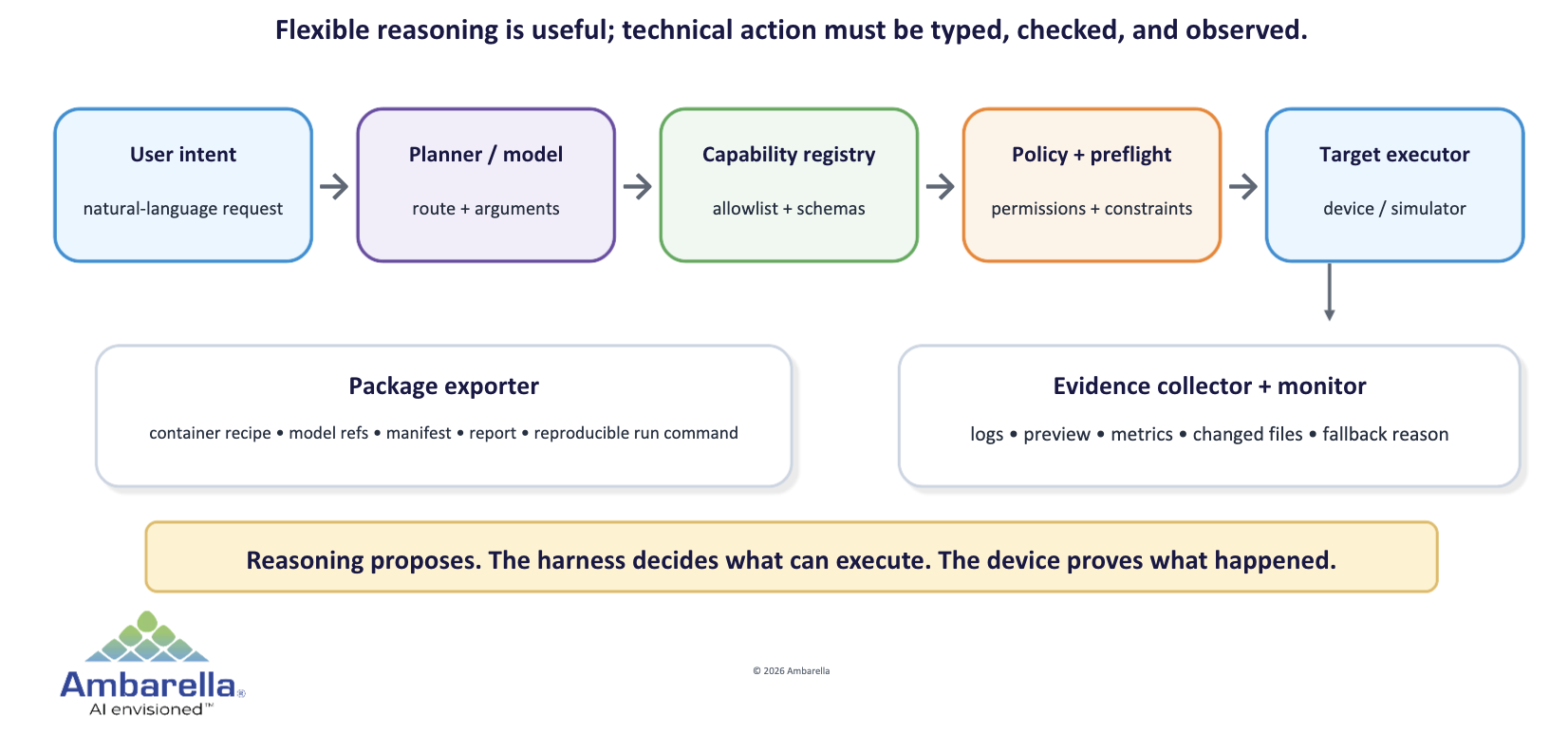
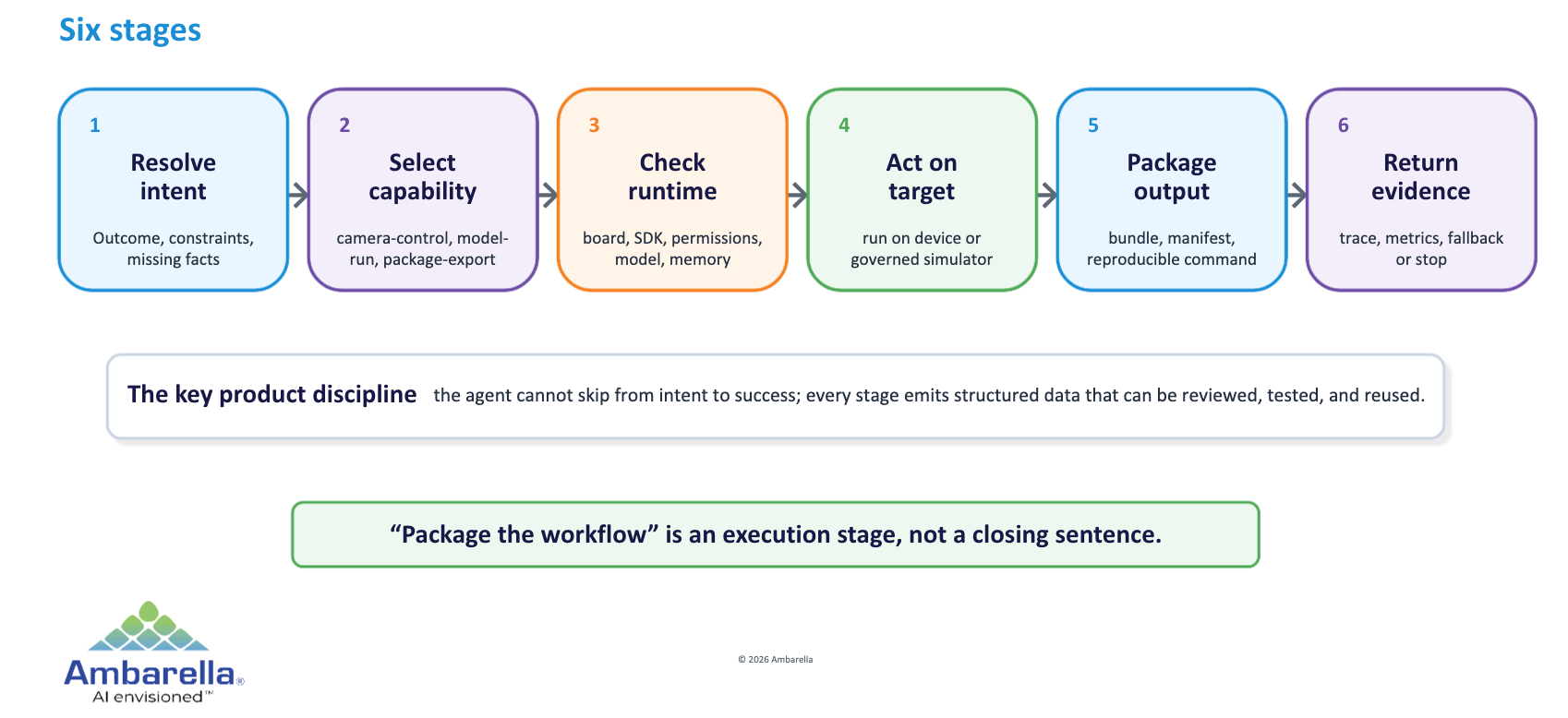
Closing the intent-to-execution gap for edge AI starts with hardware-aware execution planning. The tool must understand what the target device actually supports before it generates any code. This means querying the device for its SDK version, available operators, supported model formats, and accelerator capabilities, and selecting an execution path grounded in confirmed device state. If the preferred path is unavailable, the tool should descend through defined alternatives, each step logged and visible to the developer, until it reaches a viable configuration.
Execution planning alone is insufficient without structured platform knowledge to guide it. The expertise that currently lives in senior engineers’ heads needs to be encoded in a form that a development tool can traverse. One approach gaining traction is to organize platform operations as a formal knowledge structure: a defined set of capabilities, each tied to specific SDK operations, annotated with device and version awareness, and sequenced according to validated execution patterns. This kind of structure allows smaller, more efficient language models to complete tasks that would otherwise require the accumulated judgment of a specialist engineer.
The structure works because it limits what the agent is allowed to do. When an agent acts on a target device, it should work through a defined set of harness endpoints that map to validated SDK operations, rather than generating free-form code and assuming it will run. Each endpoint is a known-good operation that the platform team has already tested on real hardware, so the agent assembles its work from proven building blocks instead of writing an implementation from scratch each time. An agent bounded this way executes along paths the platform has already validated, which is what lets the structured knowledge above it produce behavior that works on the device. The agent is never left to guess at operations it cannot verify.
The most consequential requirement, and the one least addressed by current tooling, is verification against real device behavior. The gap between code that looks correct and code that runs correctly on the target device is where most embedded AI projects lose time. A rigorous development tool for this environment would separate implementation from verification, using independent evaluation processes that test the full system under actual runtime conditions on the target hardware. The discipline is grounding validation in observable device behavior, not in the tool’s confidence that its output is correct.
Why this matters for ecosystem scale
Edge AI silicon companies are competing to build the broadest possible developer ecosystems. The commercial logic is direct: the platform with the most productive developer experience attracts the most ISVs, OEMs, and system integrators, which generates the most production deployments and the strongest long-term revenue base.
Today, the primary tools for expanding that ecosystem are model zoos/collections, reference applications, documentation, and sample code. These resources are necessary, and they work. The constraint is that they scale linearly: each new model, each new example, each new tutorial requires authoring, testing, and maintenance. The opportunity that intelligent development tools represent is a shift from linear scaling to compounding leverage. If platform expertise can be encoded into the tooling itself, every developer who uses the tool benefits from the full depth of the platform team’s knowledge, without requiring a one-to-one knowledge transfer for each new project.
That is the direction this industry is heading. The companies that get there first will have a meaningful structural advantage, because they will be able to grow their ecosystems at a rate that is no longer gated by how many engineers they can hire to write documentation and answer support tickets. The constraint shifts from transferring knowledge person-to-person to embedding that knowledge in the tools themselves, and the developers who benefit from that shift will be the ones who stay on the platform.
What comes next
“Everything Is Going to Be Driven by Algorithms” described a world in which intelligence migrates to the device. The open question is what it takes to get from that vision to production-grade systems that run reliably on constrained hardware at scale.
The architectural pattern that emerges from this analysis has several components: hardware-aware execution planning grounded in confirmed device state, structured platform knowledge organized for machine traversal, verification against real runtime behavior on the target device, and a clear path from working prototype to deployable artifact. These are not speculative requirements; rather, they are the minimum conditions for closing the gap between what a developer intends to build and what actually runs on the hardware. The thread that connects them is constraint. An agent that operates through validated, hardware-grounded operations can be trusted in a way that an agent generating free-form code cannot, because its actions are bounded by what the platform has already proven works. The next pieces in this series will go deeper into how these systems are built, validated, and ultimately trusted to operate on their own.